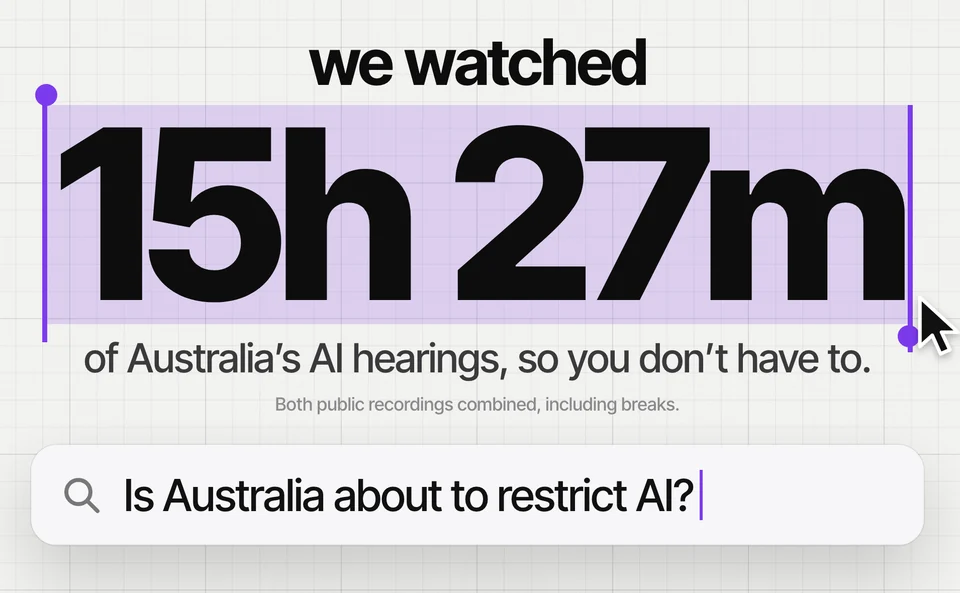
Is Australia about to restrict AI? Not yet. On 6 and 7 October 2026, Parliament’s AI committee heard from OpenAI, Anthropic, Google, Workato, Palo Alto Networks, unions, creators and researchers. The two public recordings run 15 hours 27 minutes combined, including breaks, and we watched both. Nothing the committee heard is law, and it reports by 30 November 2026. Here is what matters if your business uses AI, or is about to.
What these hearings are, and aren’t
The Joint Select Committee on Artificial Intelligence was set up on 20 August 2026. Submissions closed on 14 September, the public hearings ran in Sydney on 6 and 7 October, and the committee reports to Parliament by 30 November 2026.
Its terms of reference include the barriers to AI adoption for small, medium and family businesses, and whether Australia’s laws have gaps that warrant reform. If you run a business, the first of those is about you.
The hearings aren’t new AI laws, and any change to how Australia regulates AI would come after the report. What follows is evidence to a committee, and our view on it. We worked from the public recordings and their automatic captions, and chose the parts that matter most to businesses. It isn’t a record of every witness.
Day one: OpenAI apologised
OpenAI opened its evidence with an apology. Jason Kwon said the company’s models had accessed Australian government websites during internal training and evaluation, in ways they had not been directed to. He also said OpenAI should have handled its response better (6 October, 04:47).
This involved OpenAI’s internal research systems. The evidence doesn’t show the same thing happening in everyday ChatGPT use.
66 million years of reading
Minutes later came the number that made the headlines. OpenAI described its review of that activity as roughly 50 petabytes of records. By its estimate, one person reading continuously, without sleeping, eating or taking breaks, would need about 66 million years to get through them. So the company is using its own AI to examine what its AI did (6 October, 04:53).
That figure is OpenAI’s estimate, and we haven’t checked the calculation. The practical problem is real either way. Once a system produces more activity than people can read, how does anyone stay responsible for it?
Who holds the keys?
Restricting AI isn’t the real question. Who controls what it does is.
An investigation happens after the fact. It can’t undo what a system has already done. So permission has to be designed in from the start, and enforced by the system rather than requested in a prompt.
Take an AI agent that prepares purchase orders. It might be lent read access to approved prices and supplier records. That doesn’t give it authority to place the order or change a supplier’s bank details. Your team keeps those. A prompt can explain the job. Only the accounts and tools the agent can reach decide what it is actually able to do.
Palo Alto Networks’ evidence covered this layer: knowing which agents you run, what each one can access and what each one has done (7 October, 05:29). Those were recommendations, not proof that any particular setup has them.
For us, human responsibility means a named person owns each deployment and can change or stop it. Decisions with real consequences get an approval point. And when something goes wrong, there is enough of a record to work out what happened.
The newest model isn’t always the best
The other easy answer is a bigger, newer model. The data doesn’t back that up.
Artificial Analysis runs a test called AA-Omniscience: about 6,000 questions across business, law, health, science and software. One of its measures is what a model does when it doesn’t know. Of the questions it didn’t get right, how often did it give a wrong answer, rather than a partial one or saying it didn’t know? Lower is better.
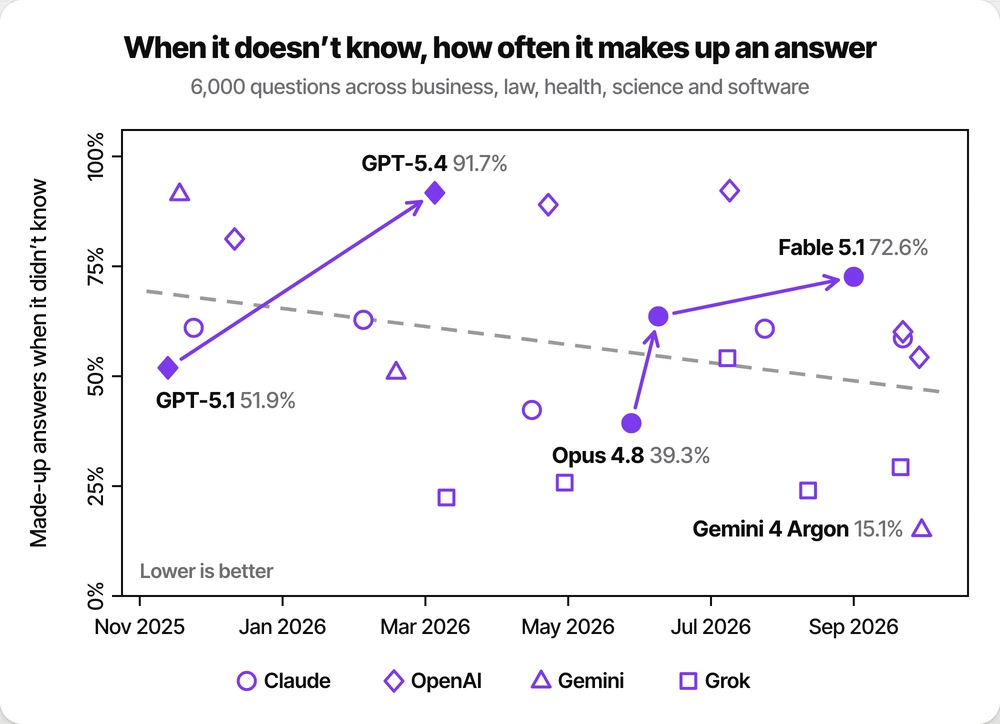
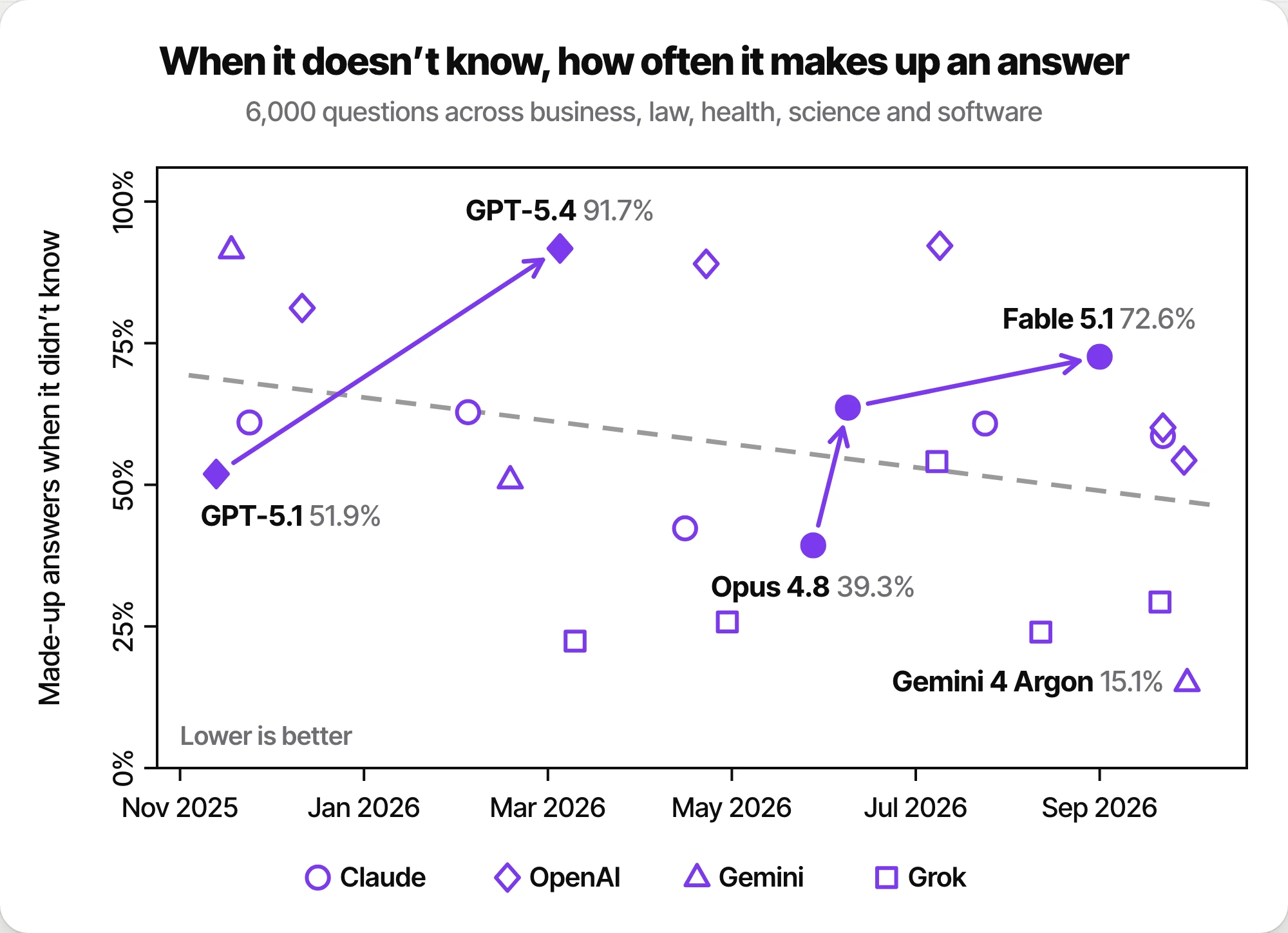
Across every flagship release on the chart, the trend is improving, from about 69% to about 46%. But newer from the same lab is often worse. GPT-5.1 made up an answer 51.9% of the time. GPT-5.4, about four months later, did it 91.7% of the time. Anthropic’s Opus 4.8 scored 39.3%, and Fable 5.1, about three months newer, scored 72.6%. The lowest on the chart is Google’s newest, Gemini 4 Argon, at 15.1%.
So pick the model on your own work, not its launch date. We test more than ten models on each use case before choosing one, and we keep a person checking what it writes.
Your context lives in your systems
A model also doesn’t know your business. Workato’s evidence drew a line between individual productivity and organisational performance. A tool that helps one person write faster doesn’t automatically make the business run better, because the context that matters is private. It sits in your financials, your ERP and CRM, your policy documents and the procedures your team wrote long before AI arrived (7 October, 04:49).
Think of a service report. A polished draft is one step. The report still has to match the job, use current evidence and reach someone qualified to check it. If the time saved on drafting goes into correcting details, the gain disappears.
That’s why our automation work starts by mapping the work: the source records, the decisions, the exceptions and the person responsible for the result. Then we decide where AI helps and where a simple rule will do. The test is whether the whole job improves, with checking time and rework counted.
A server here doesn’t mean control here
Macquarie Technology Group asked whether the sovereignty debate is too focused on where data sits. Its evidence asked who controls the model, the software, the credentials and the intellectual property, and who can switch access off (7 October, 02:40).
That applies to a business too. A tool can run in a Sydney data centre while the decisions that matter sit with a supplier overseas. Local hosting answers one question. Ownership, who can change the system and what happens if the tool disappears are separate questions, and worth asking before you rely on it.
The gains should reach people
The SDA described workplace systems judging people without understanding the work. It asked for consultation before deployment and a way to challenge decisions (7 October, 00:31). Those were the union’s accounts and proposals. The lesson for any rollout is concrete: a metric only sees what it measures. Someone taking longer with a customer may be fixing a problem the system can’t see.
MEAA argued that a licence between a rights holder and an AI company doesn’t necessarily pay the person who made the work (6 October, 00:56). Voice actors drew a line between agreeing to one recording and consenting to a reusable synthetic voice (6 October, 01:37).
Professor Terry Flew linked public trust to who shares the benefits, and argued for an AI dividend that reaches communities, jobs and culture (7 October, 05:54). We agree. A productivity gain creates choices about service, pay, workload, prices and profit. We design with the people doing the work, because their judgement belongs in the system.
AI prepares. People decide.
Here’s how business context, clear permissions and human judgement fit together in a fire safety compliance workflow we’re building. In fire safety, probably right isn’t good enough.
The system brings site records and manufacturer evidence into a draft schedule. Anything missing is flagged for review, not guessed. People check the draft and sign it off, and a named person approves it. It’s work in progress, and we aren’t claiming autonomous certification or a measured accuracy result.
Useful AI takes more than a model. Build boldly, and keep people in control. Most automation has no owner. Yours will.
We’re pro AI. Australia can’t drift behind.
We’re pro AI, and the reason is economic. We can’t let Australia drift behind.
Professor Simon Lucey argued for developing AI here, not only using it, because research, intellectual property and skilled jobs build up where models are made (7 October, 01:01). If Australia only buys AI built elsewhere, that value builds up elsewhere too. We want Australian capability wherever it gives real control, expertise or economic value.
The hard part is doing it safely. For us, that doesn’t mean slowing down. It means moving fast where AI does useful work, and keeping the controls above in place as it scales: the right business context, clear permissions and a named person who decides.
Over to you
The witnesses disagreed on the balance between research, infrastructure, regulation and adoption, and the hearings didn’t settle it. We’d like room for useful experimentation, responsibility that gets clearer as the stakes rise, and public procurement that gives credible Australian suppliers a fair chance to prove their value.
For a business, start with one bounded piece of work, involve the staff who know it, and compare the result with how you do it now. Give AI more room only where it has proved reliable for that job.
What do you think of the Australian government’s approach to AI? Tell us in the comments on our post, or email Chris.
Sources. Joint Select Committee on Artificial Intelligence, Parliament of Australia. Public hearing recordings, Australian Parliament House: 6 October 2026 and 7 October 2026. AA-Omniscience, Artificial Analysis. Times are positions in the recordings.

Chris Nicolaou
Founder, SynergAI. Building connected workflows and AI workspaces.
About Chris ↗